Lesson 2.2 – Performance, Security & Scalability per CMS

Performance, Security & Scalability per CMS

Choosing the right CMS is only half the equation; aligning your server infrastructure with its unique performance, security, and scaling demands guarantees long-term stability.
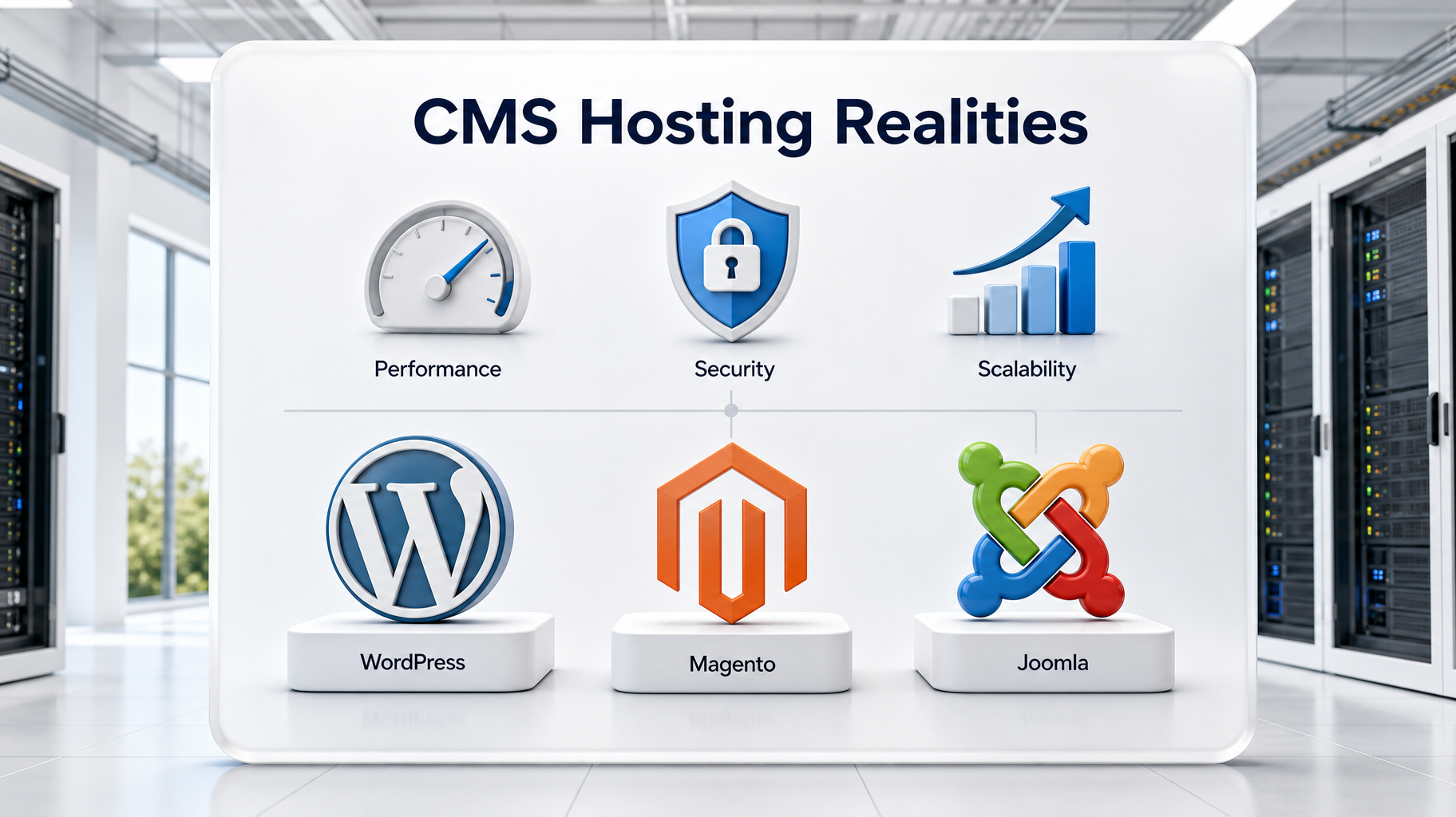
A bright white presentation board in a modern data center displaying 3D logos for WordPress, Magento, and Joomla below icons representing performance, security, and scalability.
Choosing the right CMS is only half the equation; aligning your server infrastructure with its unique performance, security, and scaling demands guarantees long-term stability.

Overview

Hosting isn’t just about where your site lives—it’s about how well it performs, how safely it operates, and how easily it grows. This lesson compares the performance, security, and scalability needs of WordPress, Magento, and Joomla, helping learners align infrastructure with platform-specific realities.


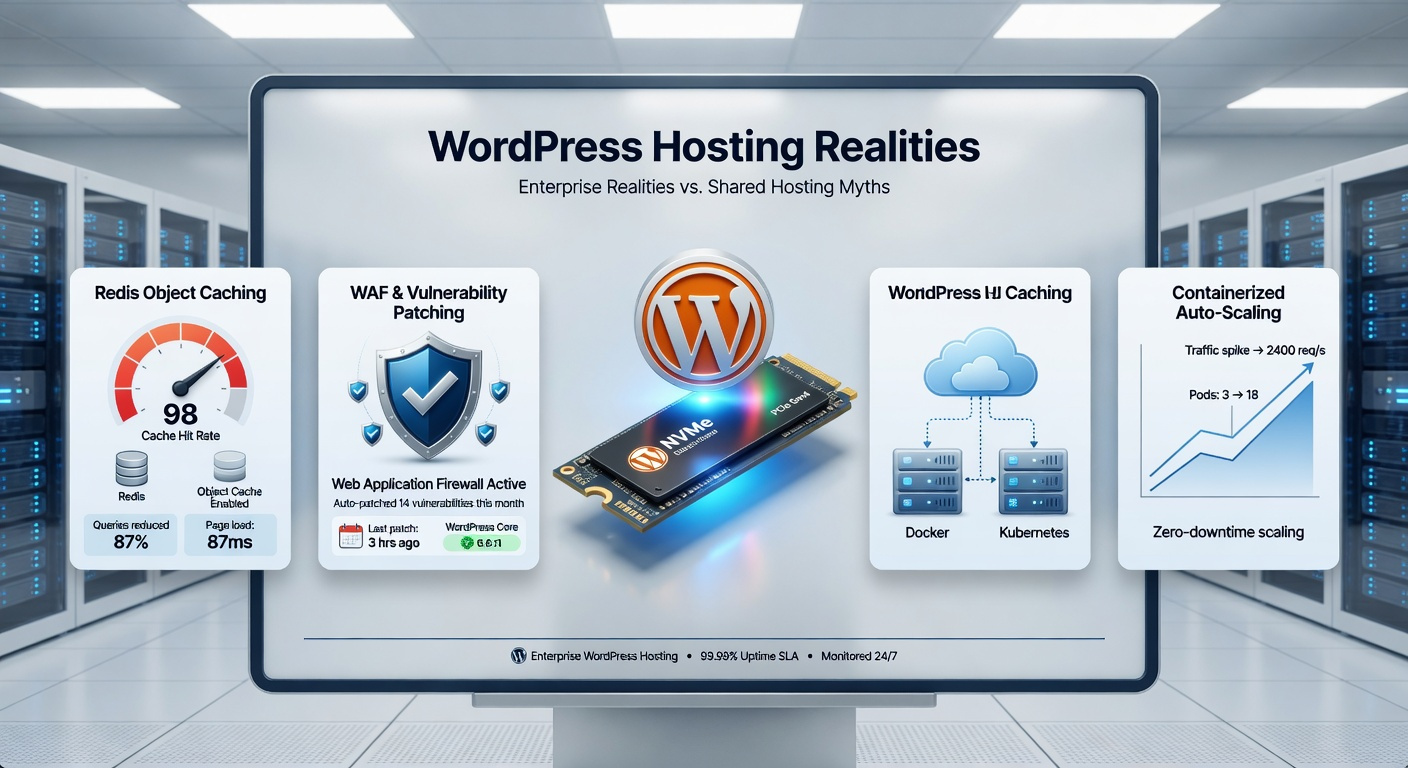
A clean white dashboard highlighting WordPress hosting realities, featuring a 3D WordPress logo on an NVMe drive, surrounded by UI cards for Redis Caching, WAF protection, and Auto-Scaling.
Enterprise-grade WordPress hosting relies on fast NVMe storage, persistent object caching, strict WAF protection, and containerized auto-scaling to maximize performance and security.

WordPress

Performance

  • Lightweight core, but plugins and media can slow things down
  • Benefits from SSD/NVMe storage, object caching (Redis), and CDN integration
  • PHP 8.2+ and HTTP/3 support recommended for optimal speed

Security

  • Frequent target for brute force, XSS, and plugin-based vulnerabilities
  • Requires SSL, daily backups, WAF (e.g., Sucuri), and plugin/theme hygiene
  • Update discipline is critical—auto-updates help, but manual review is safer

Scalability

  • Scales well from shared to enterprise cloud environments
  • Managed WordPress hosting (e.g., Pagely, Kinsta) offers auto-scaling, staging, and containerized deployments

A bright white educational dashboard focusing on Magento hosting, displaying a heavy-duty 3D server rack alongside UI cards emphasizing Varnish caching, mandatory PCI compliance, and horizontal scaling.
Magento demands heavy CPU resources, persistent caching layers, and strict PCI-compliant security pipelines to function properly.

Magento (Adobe Commerce)

Performance

  • Resource-intensive: demands high CPU, RAM, and fast I/O
  • Requires optimized database servers, persistent caching (Varnish, Redis), and tuned PHP-FPM
  • CDN and edge caching essential for global catalog delivery

Security

  • PCI compliance is mandatory
  • Needs strict access controls, secure deployment pipelines, and regular patching
  • WAF protection for checkout and admin panels is non-negotiable

Scalability

  • Built for growth: supports multi-store setups, global traffic, and large catalogs
  • Best hosted on VPS, dedicated, or cloud platforms with horizontal scaling and container orchestration (e.g., Kubernetes)

A clean white dashboard illustrating Joomla hosting needs, showing a 3D Joomla logo and structured data blocks, with UI cards detailing moderate resource use, extension hardening, and flexible VPS allocation.
Joomla offers a scalable, secure architecture with moderate resource needs, heavily relying on strict extension management and permission hardening.

Joomla

Performance

  • Moderate resource usage; runs well on shared or VPS hosting
  • SSD/NVMe storage, caching plugins, and CDN integration improve speed
  • PHP 8.1+ and MySQL 8+ recommended

Security

  • Needs SSL, backups, and firewall protection
  • Extension management and permission hardening are key
  • Regular updates and monitoring reduce risk from third-party components

Scalability

  • Ideal for multilingual and structured content sites
  • Scales effectively on cloud or VPS hosting with flexible resource allocation

Visual Summary

CMS Performance Needs Security Focus Scalability Path
WordPress SSD/NVMe, caching, CDN WAF, backups, plugin hygiene Shared → Managed → Cloud
Magento High CPU/RAM, DB tuning PCI, WAF, secure deployments VPS/Dedicated → Cloud
Joomla SSD, caching, CDN SSL, extension control Shared/VPS → Cloud

Key Takeaways

  • WordPress is flexible but benefits from managed environments and caching.
  • Magento demands high-performance hosting with strict security and compliance.
  • Joomla sits in the middle—scalable and secure with moderate resource needs.
  • Matching hosting to CMS ensures better performance, fewer issues, and stronger security.
Exercise Files
Lesson 2.2 Checklist (docx)
6.77 KB