
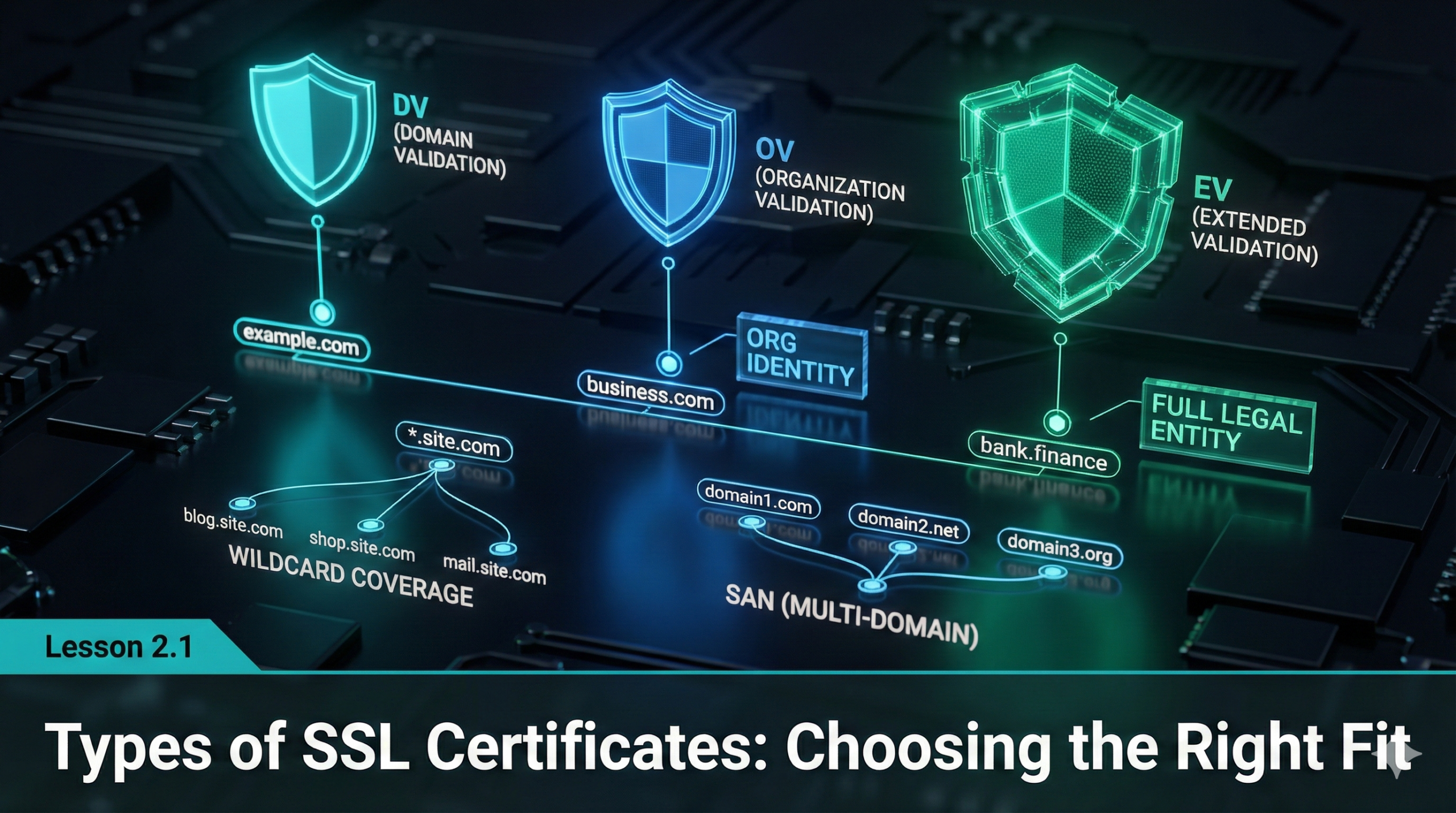
Overview Not all SSL/TLS certificates are the same. This lesson explains the different types of certificates available, what each one validates, and how to choose the appropriate option based on your website’s structure, audience, and trust requirements. Understanding these distinctions helps prevent misconfiguration and ensures the right level of authentication and coverage.
Domain Validated (DV) Certificates DV certificates verify domain ownership only. The Certificate Authority (CA) confirms that the applicant controls the domain, typically via DNS record or email validation.
- Fast issuance (often within minutes)
- Minimal validation requirements
- Suitable for personal sites, blogs, and internal tools
- Provides encryption but limited trust indicators
DV certificates are widely used due to their simplicity and cost-effectiveness, but they do not verify the identity of the organization behind the site.
Organization Validated (OV) Certificates OV certificates verify both domain ownership and the legal identity of the organization. The CA checks business registration records and confirms operational legitimacy.
- Issued within 1–3 business days
- Displays organization details in the certificate metadata
- Recommended for business websites, e-commerce platforms, and service providers
- Offers stronger trust signals than DV
OV certificates help users confirm that they are interacting with a legitimate business entity, not just a domain owner.
Extended Validation (EV) Certificates EV certificates involve the most rigorous validation process. The CA verifies legal, physical, and operational existence, including documentation and direct contact.
- Issued after comprehensive vetting
- Historically triggered green address bars in browsers (now deprecated)
- Still displays verified organization name in certificate details
- Ideal for financial institutions, government portals, and high-trust environments
EV certificates are designed to maximize user confidence, especially where sensitive data is exchanged.
Wildcard Certificates Wildcard certificates secure a domain and all its subdomains at one level. For example, a wildcard for *.example.com covers:
- www.example.com
- blog.example.com
- shop.example.com
They can be DV or OV, depending on the provider. Wildcards simplify management for sites with multiple subdomains but do not cover multiple domain names.
Multi-Domain (SAN) Certificates Subject Alternative Name (SAN) certificates allow multiple distinct domains to be secured under one certificate. For example:
- example.com
- example.org
- example.net
SAN certificates can be DV, OV, or EV. They are useful for organizations managing multiple brands, services, or regional domains.
Choosing the Right Certificate Selection depends on your site’s structure and trust requirements:
- Use DV for quick encryption on personal or internal sites
- Use OV for public-facing business sites
- Use EV for high-assurance environments
- Use Wildcard for multiple subdomains under one domain
- Use SAN for multiple domains managed by the same entity
Misalignment between certificate type and site structure can lead to trust errors, coverage gaps, or unnecessary complexity.
Key Takeaways
- DV certificates validate domain ownership only
- OV and EV certificates validate organizational identity
- Wildcard certificates cover unlimited subdomains under one domain
- SAN certificates cover multiple distinct domains
- Choosing the right certificate ensures proper coverage, trust, and operational efficiency